By Gaëtan Vaudry
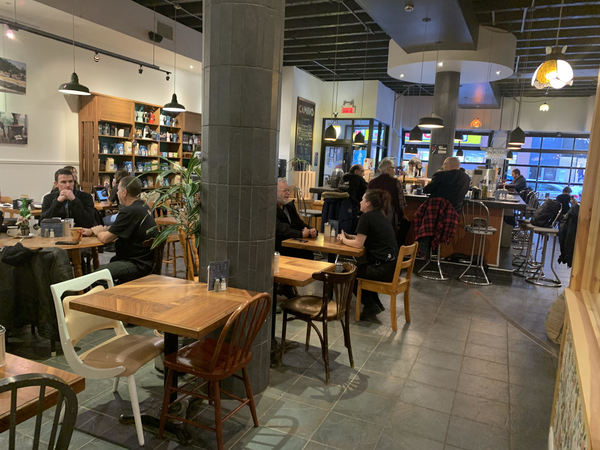
During our brief stay of a few days in the city of Saguenay, we couldn’t help but stop at Café Cambio on Racine East Street four or five times. Firstly, to enjoy the atmosphere of this downtown Chicoutimi solidarity cooperative, and secondly, to savor affordable and healthy dishes that showcase products from various local producers.
As soon as Virginie Simard-Dufour starts talking about the products available at this fair-trade and organic micro-roastery founded in March 2005, her eyes light up. She speaks passionately about the tireless teamwork of 32 members, including 10 worker-members: “
Under the label, we embody a vision of a better world—one where farmers and workers sit at the negotiating table as equals
,” proudly notes the service manager, restaurant coordinator, and barista.
Café Cambio, a key gathering spot for students from the Chicoutimi CEGEP and the Université du Québec à Chicoutimi (UQAC), is also a venue for showcasing young Saguenay artists. The establishment regularly hosts art openings and intimate acoustic concerts of emerging music.
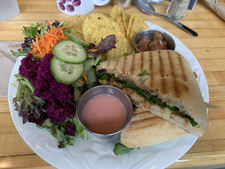
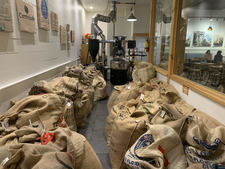
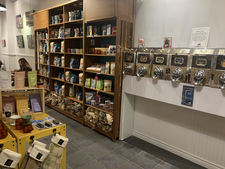
During my visit last November, I had the chance to enjoy some excellent dishes at this establishment, which was the brainchild of two young Montrealers and childhood friends, Guylaine Pelletier and Geneviève Demers. To start, I had a comforting mushroom soup, perfect for that time of year. I followed it with the spicy Bedi panini (Cajun-seasoned chicken, caramelized onions, spinach, mozzarella, and vegenaise), served with salad, corn chips, and salsa. For dessert, I enjoyed the daily special, all accompanied by one of their excellent fair-trade coffees. To my surprise, the bill for this delicious three-course meal was very affordable!
What also struck me during my first visit was their “Pay it Forward” concept, where customers can anonymously donate a soup or coffee to someone in need. Given the growing issue of homelessness in downtown Chicoutimi, this gesture of generosity is truly admirable and meaningful.
Café Cambio’s coffee and products are available at various points of sale across the Saguenay–Lac-Saint-Jean region, including Chicoutimi, Jonquière, La Baie, Saint-Ambroise/Saint-Honoré, MRC Lac-Saint-Jean-Est, MRC Domaine-du-Roy, Bas-Saguenay, Saint-Fulgence/Sainte-Rose-du-Sacré-Cœur, Tadoussac, Les Bergeronnes, Les Escoumins, and even the Côte-Nord!
Café Cambio
414, rue Racine Est, Chicoutimi
418 549-7830
cafecambio.ca
Nothing seems to dampen the enthusiasm of entrepreneurs Sébastien Després and Heather Wright (photo), the owners and shareholders of Shediac Wonderland. After the Auberge Le Griffon, the Moque-Tortue restaurant, and the Adorable Chocolat café-chocolaterie, they are now embarking in 2024 on the revival of the Neptune drive-in theater, its canteen, and have become concessionaires of the Parlee Beach canteen at Pointe-du-Chêne Provincial Park.
The announcement of the drive-in reopening on May 17 received positive feedback from the community and the region. “This addition to our collection of Alice in Wonderland-inspired establishments will keep its historic name (Neptune) while adopting the imaginative fantasy that has made Shediac Wonderland renowned, our company that oversees all these establishments,” say Sébastien and Heather. In this spirit, the drive-in and beach canteens will be named Morse et Marteaux.

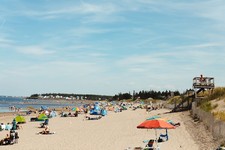
The drive-in and Parlee Beach canteens will be called Morse et Marteaux
A Wood-Fired Meat Smoker
Additionally, Sébastien Després dreamed of a Texan-style meat smoker to supply his Moque-Tortue and Adorable Chocolat kitchens. After visiting numerous places that used such a smoker, he decided to build his own with one of his artisan-handymen. Installed at the drive-in canteen from May, it will be used to smoke wood-fired chicken and beef, which will be served at both canteens as well as in his two Shediac restaurants.
This type of equipment sells for around $30,000 in specialized businesses. The Acadian entrepreneur plans to use the experience of this first model to produce a second one that will be mobile and used to offer smoked meat barbecues from fall 2024. He already has orders for such activities at major events.
Thus, the menus at Moque-Tortue and the Adorable Chocolat café-chocolaterie will be modified to include smoked meat dishes. The second floor of Moque-Tortue will be freed from its sweet products kitchen to accommodate the meat preparation for all the establishments. Similarly, all sweet product production will be centralized in the Adorable Chocolat kitchen.
“The Neptune opportunity goes beyond just a drive-in accommodating 350 cars and screening films projected with an ultra-modern 4K projector. We saw it as the perfect opportunity to add equipment that will enhance the on-site dining offerings, as well as those of our other restaurants,” explains Sébastien Després.
An Anticipated Cinema Season
From May 10, the Neptune drive-in will welcome its first moviegoers in two years. This popular spot for several decades is already delighting many outdoor cinema enthusiasts, come rain or shine. Not to mention that evening activities are few in Shediac during the summer.
Visitors will enjoy quality sound technology via the FM band of car radios. Contracts signed with a dozen distributors will allow exclusive screenings of new releases as well as classic films that people love to rewatch during the peak tourist season. Occasionally, themed weeks will be presented, along with a big Halloween party at the end of the season. Moviegoers are expected to arrive early in the evening to enjoy the new culinary offerings while ensuring a prime spot for the screening starting after sunset.
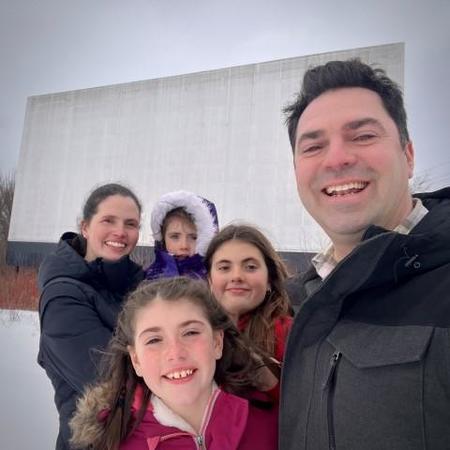 Sébastien, Heather, and their children.
All these transformations in the Shediac Wonderland universe mean that the company will manage more than 75 jobs over the coming months. Moque-Tortue boasts a quality kitchen team that delights its owner and will allow for the creation of new dishes, such as meat pies, among others. For the Adorable Chocolat café-chocolaterie, preparations are underway to offer a bar service.
Sébastien Després explains that he is confident that 2024 will mark a major turning point for Shediac Wonderland. Is he worried about facing significant challenges? “If I can't be the best in the region at what I do, I don't do it,” he answers without hesitation.
Neptune Drive-In
neptunedrivein.ca
506 351-0367
691 Main Street
Pointe-du-Chêne (Shediac), E4P 4Z9
Cantine Morse et Marteaux
parcsnbparks.info
506 351-0367
Parlee Beach Provincial Park
45 Parlee Beach Road
Pointe-du-Chêne, NB E4P 8V5
Shediac Wonderland
thewonderland.ca
506 351-0367
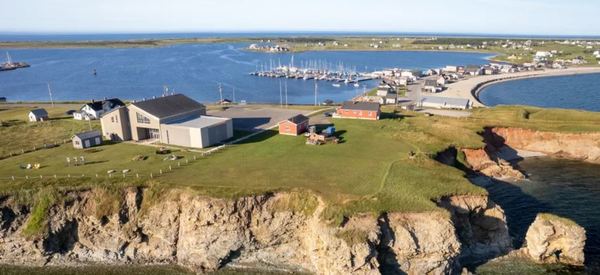
The Musée de la Mer in Havre-Aubert, located at Cape Gridley on the historic site of La Grave in the Magdalen Islands, is perched proudly on one of the region's most stunning vantage points. Since moving to this location in 1974, after spending its early years in the former parish hall of Havre following its 1969 founding, the museum has played a leading role in preserving the maritime and cultural heritage of the islands.
This mission is carried out through research, conservation, public education, and showcasing the unique insular identity that shapes life for the people of the Magdalen Islands.
For those who love striking features in museums, a highlight greets visitors in the main hall of this expanded and renovated building (completed in 2011): a whale skeleton suspended dramatically from the ceiling.
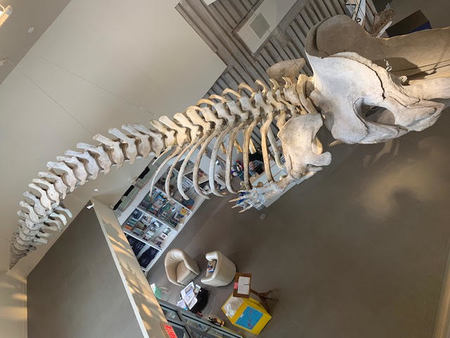
A historical note: In May 2008, a sperm whale washed ashore near Pointe-aux-Loups. After confirming its death, a group of Magdalen Islanders decided to exhibit the skeleton at the museum. Led by Claude Bourque, Pierre-Henry Fontaine, and Paul Grégoire, along with 20 other volunteers, the group spent three days dissecting the carcass. The bones were meticulously cleaned and numbered, and after over six years of preparation, the 215 bones were reassembled and installed in the museum’s main hall in December 2014.
Since late 2022, Gabrielle Leblanc has been the museum's director. She continues the work of its founder, Father Frédéric Landry, who led the museum for over 30 years. With a background in political science, literature, and project management, Ms. Leblanc has been active in the cultural and heritage sector for many years. From 2008 to 2021, she served as supervisor of cultural activities and as a cultural heritage and library coordinator for the Municipality of the Magdalen Islands.
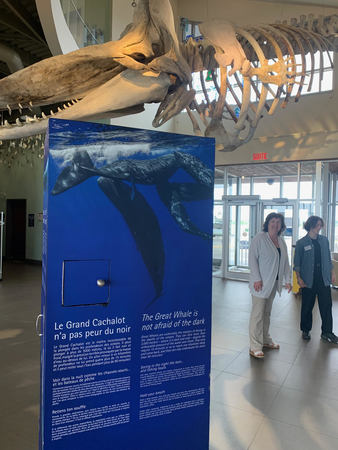
On August 8, 1969, the Museum of the Islands was inaugurated in the presence of Quebec Premier Jean-Jacques Bertrand. In 1972, the museum relocated and was renamed Musée de la Mer. The Quebec government provided a $200,000 grant to construct a dedicated building for the museum.
Engaging Exhibitions and Captivating Activities
"The Musée de la Mer provides an immersive experience into Magdalen culture through its year-round exhibitions and activities. Visitors can expect a warm welcome from our inspiring and passionate staff, as well as outstanding permanent and temporary exhibitions suitable for the whole family," says Gabrielle Leblanc.
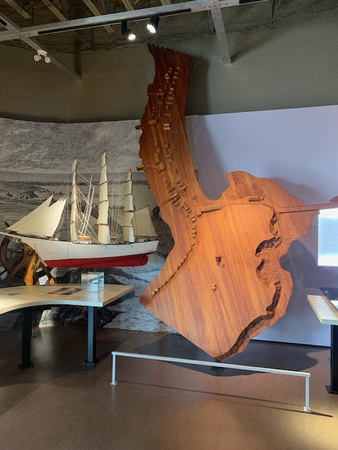
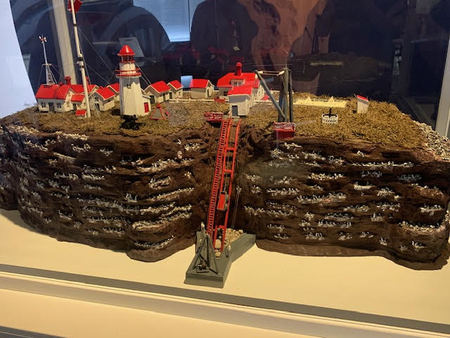
The permanent exhibition "Living on the Islands, Living the Islands," along with rotating displays featuring local artists, genealogical resources, maritime artifacts, and lectures, awaits the many visitors each year. Topics range from fishing traditions to shipwrecks, offering something for both locals and tourists.
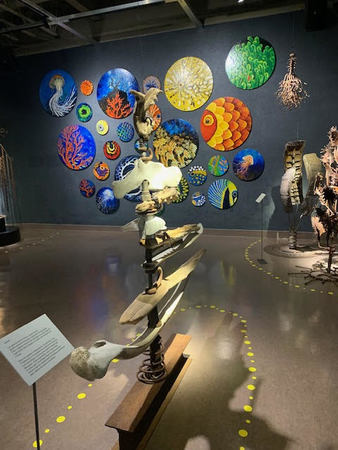
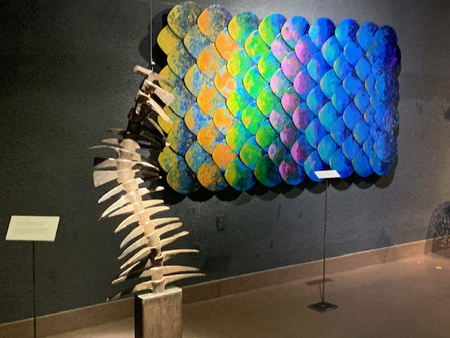
From May to October 2023, visitors can explore Annie Morin’s multidisciplinary exhibit, "A Walk on the Ocean Floor." This stunning showcase features sculptural and pictorial works inspired by the organic forms of the ocean and the interplay between its fragility and strength.
A notable event occurred in February 1971 when the museum hosted the exhibit "The Moon Lands on the Islands," featuring moon rocks brought back by Apollo 11 in 1969.
In July 1987, the Islands Aquarium was inaugurated in the historic Saltworks building at La Grave. It showcased the flora and fauna of the Gulf of Saint Lawrence. Although its focus shifted in 2017, the building now features a second-floor exhibition on La Grave’s history and cultural activities on the ground floor during summer. Experts are working to secure the 1895 structure to preserve its heritage.
The Musée de la Mer is a non-profit organization managed by a board chaired by Normand Thellab. It employs a multidisciplinary team and hosts researchers in archaeology and forensic anthropology each summer.
Musée de la Mer
museedelamer-im.com
1023, chemin De La Grave
Havre-Aubert, QC G4T 9C8
418 937-5711
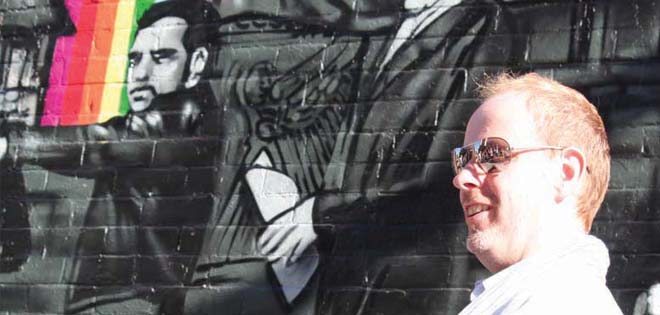
Glenn Crawford was the instigator of the Build Our Bank and LGBT Village initiatives in the famously reserved capital since starting the volunteer-run project in 2007. While he has recently stepped down as president of The Village, making room for new ideas from successor Ian Capstick, Crawford has left an indelible mark on a town where there wasn’t a lot of consensus about creating a gay village.
Born out of town hall meetings about the reconstruction of Bank Street, the idea of designating the stretch between Wellington and Gladstone as The Village was about “trying to get a sense of belonging and place, where people feel they can be themselves, have access to services, fool around and shop,” Crawford says. “Gradually a lot of LGBTQ organizations have coalesced into this area… Forming The Village was a natural progression.” When he started fundraising and participating in public advisory committees five years ago, Crawford came up against both the veiled homophobia of a local business improvement association, as well as criticism from the LGBT community that the project was coming 10-20 years too late.
“People were asking Why do we want to create a ghetto? A lot of that criticism comes from people who are out [of the closet],” Glenn says with his typical incisiveness, “from people who have the relationship, two dogs and friend circle. I don’t need a Village either! It’s for people who are struggling in suburban or rural areas; it can be for everyone.” And as a child of the sleepy, inaccessible suburb of Kanata – “not an easy place to grow up gay” – Crawford speaks from experience. Like most LGBT people in any Village in any major city anywhere, the urban geographic bubble exists as much for townies as it does for people who have moved there to escape the stifling places they come from.
And lest you think that Crawford’s project was for commercial reasons alone, it may seem counterintuitive that he’s not a shop-keeper himself, but rather a website and graphic designer who lives just off Bank and works part time in a local gallery. “There’s a social aspect to it. Taking pride in who you are and finding a sense of value in there being a community,” which for him includes keeping the subsidized housing in the area, and watching out for condo development that could “force out the funkier elements.”
“It’s [about] putting roots down; people say it’s 20 years too late, but for me it’s just in time,” Glenn concludes. Echoing a theme that has emerged in everything from architecture to sociology, he adds that “The online world is not the same as having a real community. I worry about that, about younger generations, they’re not valuing the sense of community.”
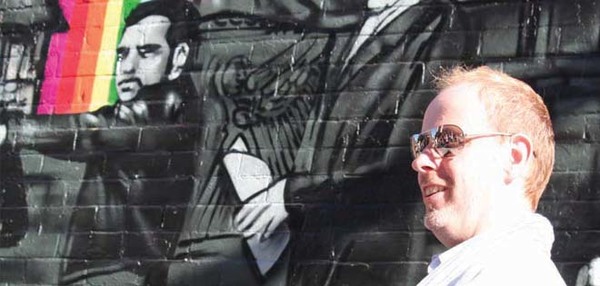
So maybe when you walk by the “We Demand” mural that The Village commissioned on Gladstone and Bank Streets, you might get a sense of what that community looks like and is for, and clap your fairy hands for Glenn Crawford.
Photo by Noreen Fagan